
The Homeowner’s Guide to Safely Using Bleach for Pressure Washing
That green siding, the stained driveway, the slippery film on your patio, these are the projects that make a you reach for the pressure washer. It's a satisfying job to tackle yourself, blasting away years of grime to reveal the clean surface underneath. But if you want professional-level results, the secret isn't just about brute force; it's about using the right chemicals safely and effectively.
Let's be clear: bleach is a powerful chemical that demands respect. But fear and hesitation lead to mistakes. This guide replaces that uncertainty with the professional knowledge you need to use it like a pro, achieving a deeper, longer-lasting clean without damaging your property or putting yourself at risk.
Bottom Line Up Front:
• You'll learn why professionals use "SH" (Sodium Hypochlorite), not just laundry bleach, and where to find it.
• We'll cover the non-negotiable safety gear required to handle these corrosive chemicals.
• You'll understand the correct order of operations; Why you often wash before applying chemicals.
• We'll provide straightforward dilution ratios for different surfaces like siding, brick, and roofs.
• You'll get essential tips for protecting your equipment and landscaping from damage.
1. It's Not Just Bleach: Understanding the Right Chemical for the Job
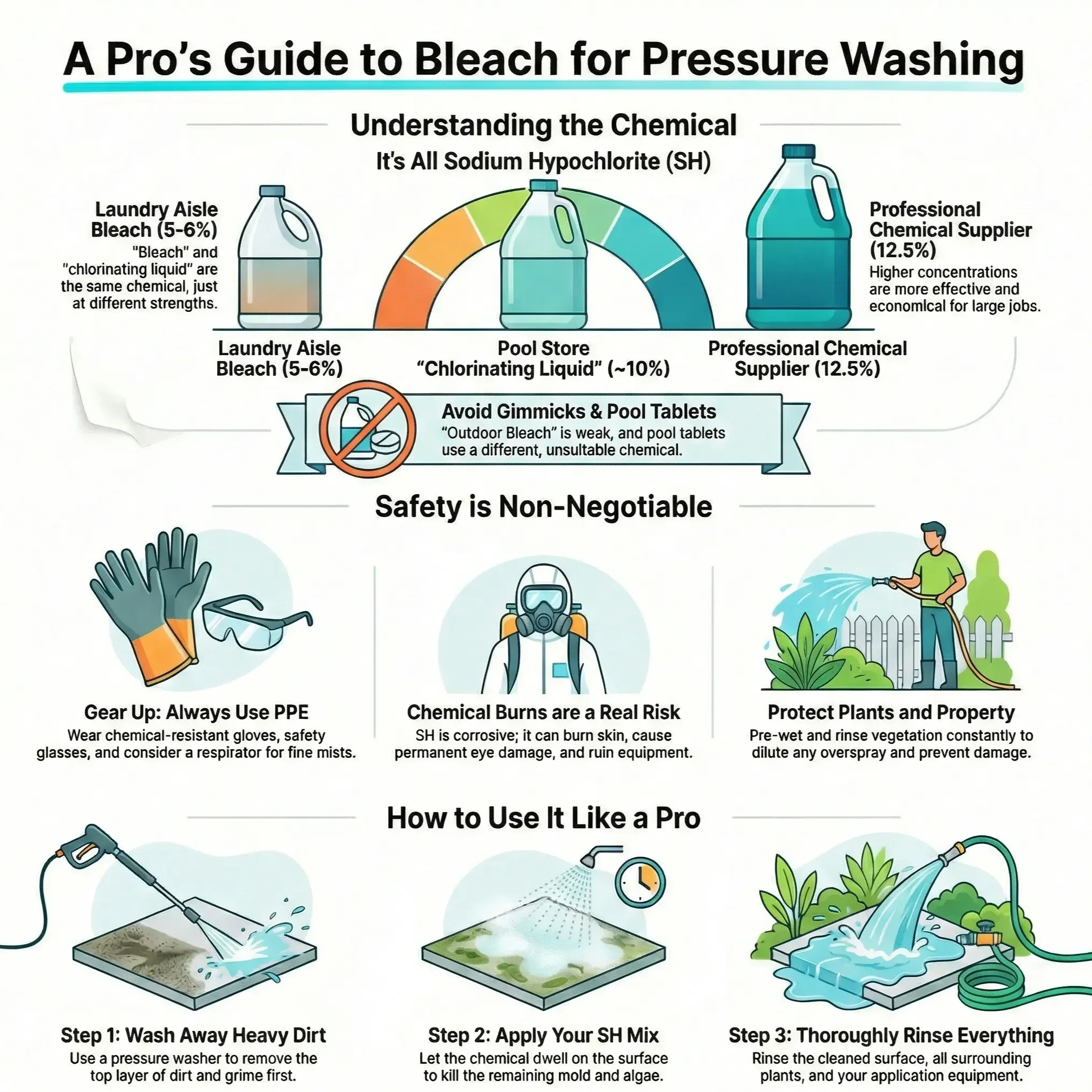
The product we use is technically called chlorine, and its active ingredient is Sodium Hypochlorite. This is the same chemical found in household laundry bleach, but the key difference—and the most important factor for your projects, is the concentration.
• Standard Laundry Bleach: Typically has a Sodium Hypochlorite concentration between 5% and 8.25%.
• Pool Aisle "Chlorinating Liquid": A step up, usually found at around 10% concentration. This is a great, readily available option for homeowners.
• Professional-Grade Supply: Can be purchased from chemical suppliers at 12.5% concentration.
Pay attention to the percentage on the label; it tells you the real strength of the product. Avoid marketing gimmicks like "outdoor bleach," which is often just regular-strength bleach in a different bottle. And never use pool shock tablets. Their active ingredient is different and not suitable for this kind of cleaning.
Pro-Tip: Where to Buy the Right Stuff
• The pool aisle of big-box stores like Walmart, Lowe's, and Home Depot.
• Local pool supply stores.
• Industrial chemical suppliers (try searching for "industrial chemical vendors near me").
2. Safety First, Always: Gearing Up to Handle Corrosive Chemicals
Sodium Hypochlorite is a corrosive chemical. It doesn't know the difference between algae on your siding and your skin. Direct contact can cause severe chemical burns that can result in a "little bleeding blister area." The risk is real, and working without the proper protective gear is simply not worth it.
Pro-Tip: Your Essential Safety Kit
• Chemical-resistant rubber gloves: Absolutely mandatory to prevent skin contact and painful burns.
• Safety glasses: Protect your eyes from splashes, which can happen when pouring the chemical or when the wind shifts during application.
• Breathing protection (mask): Especially important if you're using a fine-mist sprayer or working on a windy day, as the mist can blow back into your face.
3. Technique Trumps Power: The Correct Order of Operations
The reason we use bleach is to kill organic growth. The mold, mildew, and algae that cause discoloration. By letting the chemical do the heavy lifting, we can clean surfaces with low pressure, a technique known as "soft washing." This prevents the damage that high pressure can inflict on siding, wood, mortar, or aggregate.
The professional Standard Operating Procedure is a three-step process: Wash -> Apply Chemical -> Rinse. We use the pressure washer first to remove the top layer of loose dirt and grime. This allows the chemical, applied next, to attack the deep-set organic stains directly instead of just sitting on top of the mud. After the chemical has had time to work, a final rinse clears everything away.
However, for a homeowner, there’s a more practical approach. Here's the "Homeowner Test": Try pressure washing a section first. If it looks clean, you're done. If you see streaks or shadowing after the surface dries, that’s your sign that organic growth is still present and it’s time to apply your chemical solution to that pre-cleaned surface. This saves you from using chemicals when they aren't necessary.
4. Getting the Mix Right for Your Project
The 10% or 12.5% Sodium Hypochlorite you buy is a concentrate and must be diluted with water before use. Using it straight is overkill for most surfaces and increases the risk of damage to your plants and property. The final percentage of your mix will depend on the surface you're cleaning.
Here are some general guidelines for your final diluted mixture:
• House Wash (Vinyl Siding, etc.): 1% to 2%
• Cement or Aggregate Post Treatment: 1% to 2%
• Brick & Stucco: 2% to 3%
• Roof Cleaning: 5% to 6%
To help your mix cling to vertical surfaces and boost its cleaning power, you can add a small amount of surfactant or soap. A simple option is basic Dawn dish soap, added at a ratio of about one ounce per gallon of your chemical mix. This isn't just for cling; the soap "is going to loosen cobwebs... loosen wasp nests... loosen the dirt," making your final rinse much more effective. For any soaps, make sure they do not contain other chemicals that can react with your solution.
Crucial Safety Note: Always check the soap's label before mixing. Some soaps explicitly state, "do not add bleach." Mixing these products can be dangerous. Choose a soap that does not have this warning. I suggest using original DAWN. Never use DAWN Platinum.
5. The After-Wash: Protect Your Gear and Your Yard
Your job isn't done when the surface is clean. Sodium Hypochlorite is corrosive to your equipment and can harm your landscaping if you aren't careful.
Equipment Care: You must thoroughly rinse any sprayer, bucket, or container you used for the chemical solution. Flush your sprayer with plenty of fresh water. If you don't, the leftover chemical will "eat up the metal" and "corrode the seals," ruining your equipment.
Plant & Vegetation Safety: Any concentration of bleach is "not good for vegetation." To protect your plants, grass, and shrubs, the strategy is simple: water, water, and more water. Water all vulnerable vegetation thoroughly before you start applying chemicals and rinse them again after you are finished.
Conclusion: Wash Like a Pro
Pressure washing is more than just a chore; it's a transformation. Now you know what the pros know: it's not about bleach, it's about the percentage of Sodium Hypochlorite. It's not about brute force, it's about washing before you treat. With the right chemical knowledge, safety gear, and technique, you're no longer just cleaning, you're restoring your property with confidence.